Best Self Ordering Kiosk Manufacturer: Chinese Sourcing Guide
The shift toward automated guest experiences has turned the self-ordering kiosk into a critical asset for the global hospitality and retail sectors. For B2B procurement managers, China remains the primary destination for sourcing these units. The region offers unparalleled vertical integration, from sheet metal fabrication to advanced PCAP touch integration.
Choosing the right self ordering kiosk manufacturer involves more than comparing unit prices. It requires a deep dive into industrial design, component compatibility, and long-term maintenance cycles. A poorly engineered kiosk leads to high downtime, damaging both brand reputation and operational efficiency.
What Defines a Leading Self Ordering Kiosk Manufacturer in China?
Top-tier manufacturers differentiate themselves through engineering depth rather than just assembly capacity. A reliable partner manages the entire lifecycle of the product. This includes industrial design (ID), mechanical engineering (ME), and electronic hardware integration.
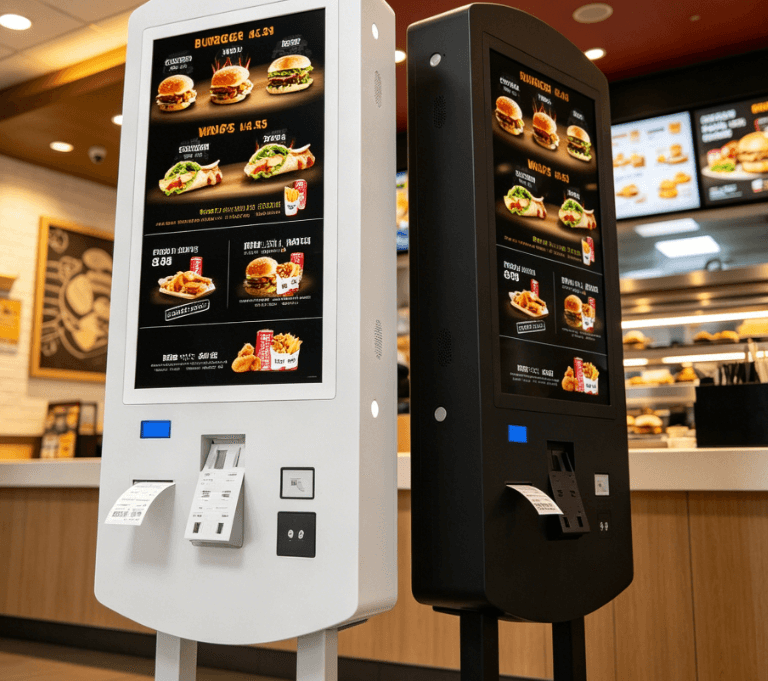
In China’s competitive landscape, the best factories utilize automated CNC laser cutting and robotic bending for enclosures. This ensures high precision and structural integrity. Cold-rolled steel or aluminum alloy enclosures are standard for high-traffic environments to prevent warping or damage over time.
Quality manufacturers also prioritize internal cable management and thermal airflow. Poorly organized interiors lead to overheating and component failure. High-end partners ensure that every internal module—from the power supply to the printer—is easily accessible for field service.
Critical Hardware Specs to Evaluate Before Selection?
When vetting a self ordering kiosk manufacturer, hardware specifications reveal the true quality of the build. Commercial-grade components are designed for 24/7 operation, unlike consumer-grade electronics.
| Component | Standard Specification | Industrial Grade |
| Touch Panel | G+G PCAP (10 Point) | Anti-glare / Mohs 7H Hardness |
| Processor | Quad-core ARM (Android) | Intel Core i3/i5 (Windows/Linux) |
| Enclosure | 1.5mm Cold-rolled Steel | 2.0mm Aluminum / Stainless Steel |
| Printer | 58mm Thermal (Manual Cut) | 80mm Thermal (Auto-cutter) |
| Brightness | 250 – 300 nits | 350 – 1500+ nits (Sunlight Readable) |
The touchscreen is the most frequently used component. A professional manufacturer will offer Projected Capacitive (PCAP) technology. This provides a smartphone-like touch experience while maintaining the durability required for public use.
How Do Customization Capabilities Impact Your Project?
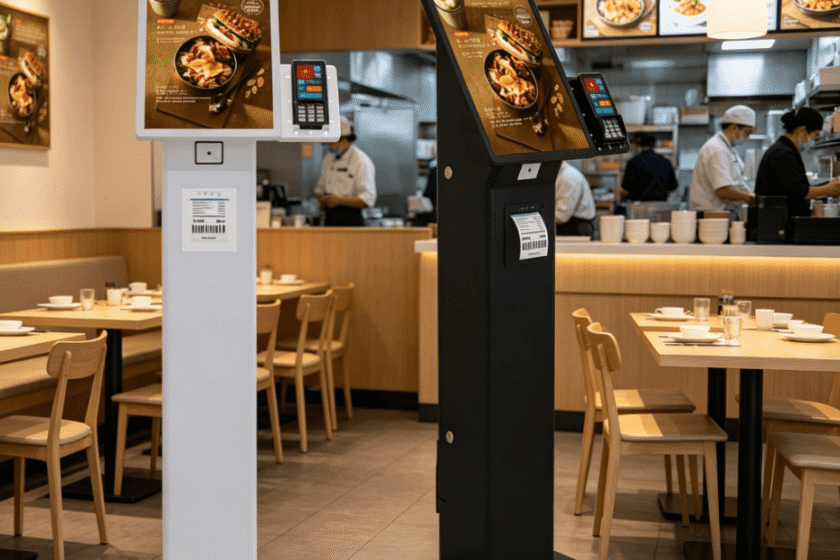
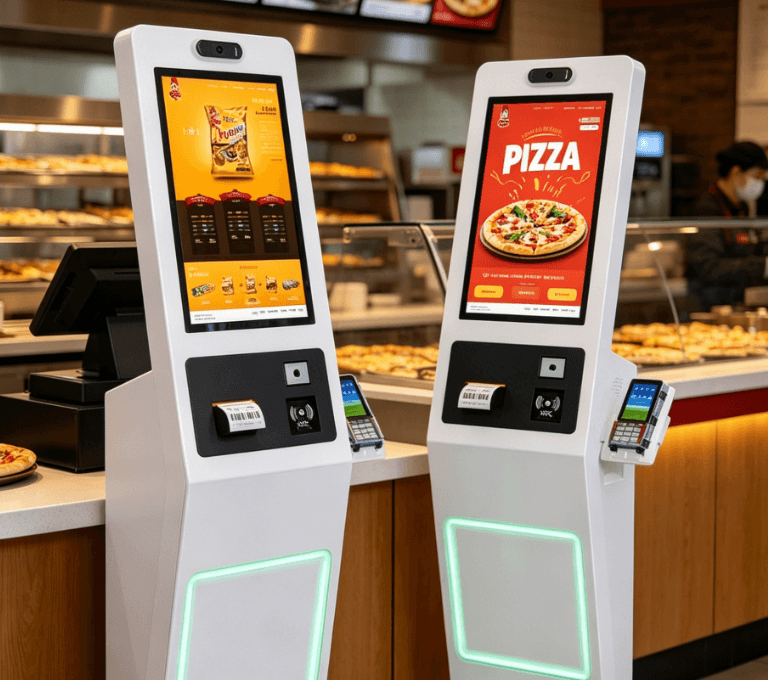
No two software environments are identical. Therefore, the ability to provide OEM and ODM services is a hallmark of an elite manufacturer. You need a partner who can modify the chassis to accommodate specific payment terminals (EFT-POS) from providers like Verifone, Ingenico, or Clover.
As a specialized factory, SV Display understands that floor-standing units may not fit every footprint. Our range of self-service ordering kiosks includes wall-mounted and desktop versions to maximize space utility. This flexibility allows brands to maintain a consistent aesthetic across various store layouts.
Modular design is essential for future-proofing. A well-designed kiosk allows for peripheral upgrades, such as adding a 3D facial recognition camera or an NFC reader, without replacing the entire enclosure. This modularity significantly extends the hardware’s lifecycle.
Why Is Thermal Management Crucial for Uptime?
Heat is the primary cause of electronic failure in enclosed kiosks. Industrial-grade kiosks generate heat from the LCD backlight, the processor, and the power bricks. Without proper ventilation, the internal temperature can exceed the operating limits of the motherboard.
Leading manufacturers design enclosures with passive heat dissipation channels. In high-performance or outdoor setups, they integrate active cooling systems with industrial fans or even air conditioning units. This prevents “blacking out” of the LCD panel and ensures the system remains stable during peak hours.
Furthermore, protection against environmental factors is necessary. For semi-outdoor or drive-thru applications, the manufacturer must provide IP65-rated front panels. This protects the sensitive electronics from moisture, dust, and cleaning chemicals used by staff.
Evaluating Quality Control and Global Compliance?
A manufacturer’s commitment to quality is proven by their testing protocols. Before any unit leaves the factory, it should undergo a series of rigorous stress tests. This includes a 48-hour “burn-in” test where the hardware runs at maximum capacity to identify early-stage component failures.
Touch Accuracy Testing: Ensuring zero latency and no dead zones across the screen.
Printer Life Cycle: Testing the auto-cutter and paper feed mechanisms over thousands of cycles.
Voltage Stability: Verifying that the power supply can handle fluctuations without rebooting the system.
Vibration Testing: Ensuring internal connectors and components remain secure during international shipping.
Compliance is non-negotiable for global rollouts. Ensure the manufacturer holds valid CE, FCC, and RoHS certifications. If you are deploying in the European or North American markets, these certifications are required for legal operation and insurance compliance.
How to Manage Logistics and Technical Support?
Shipping large-format kiosks requires specialized logistics knowledge. To prevent damage, high-quality manufacturers use honeycomb cardboard packing or fumigated wooden crates. They also provide detailed “break-apart” drawings and wiring diagrams to assist your local installation teams.
After-sales support is where the relationship is truly tested. A reliable Chinese manufacturer provides a clear warranty policy and maintains a stock of spare parts. This includes replacement touch controllers, power adapters, and printer heads that can be shipped via express courier to minimize site downtime.
Technical documentation should be comprehensive. This includes SDKs for integrated peripherals, allowing your software developers to integrate the hardware seamlessly. A manufacturer that offers remote technical support during your pilot phase is invaluable for a successful deployment.
FAQ
1. What is the typical MOQ for a self ordering kiosk manufacturer?
Most professional manufacturers in China offer a Minimum Order Quantity (MOQ) of 1 to 5 units for standard models. For full OEM projects involving custom metal molds or unique powder coating colors, the MOQ usually ranges from 20 to 50 units.
2. Can the kiosk hardware support any POS software?
The hardware acts as a shell and a computer. As long as your POS software is compatible with Android, Windows, or Linux, it will run on the kiosk. The manufacturer provides the drivers (SDKs) for the internal peripherals like the thermal printer and barcode scanner.
3. How do I choose between Android and Windows for my kiosk?
Android is often chosen for its lower hardware cost and efficient performance with dedicated apps. Windows is preferred for enterprise environments that require integration with complex legacy systems or specific peripheral drivers that are not available for Android.
4. How are kiosks protected against vandalism in public spaces?
Manufacturers use tempered glass with high Mohs hardness ratings for the screens. The enclosures are made from thick, cold-rolled steel with hidden hinges and secure locking mechanisms to prevent unauthorized access to the internal PC and cash boxes.
5. What is the average lead time for a bulk order?
For standard models, lead times are generally 15 to 25 days. Custom orders requiring new engineering samples typically take 30 to 45 days. It is important to factor in sea freight, which can take an additional 30 to 40 days depending on the destination port.
Reference Sources