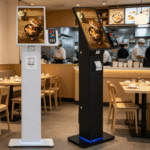
Advantages of Digital Signage Posters for Outdoor Advertising
The transition from static print media to dynamic digital displays has redefined the landscape of out-of-home (OOH) marketing. A digital signage poster for outdoor use is not merely a screen; it is a ruggedized, high-performance communication tool engineered to withstand environmental extremes while maintaining visual clarity. These systems integrate advanced liquid crystal displays (LCD) or light-emitting diodes (LED) with specialized enclosures to deliver content in environments where standard monitors would fail.
For project managers and marketing directors, understanding the technical superiorities of these systems is essential for calculating potential return on investment (ROI). Unlike traditional billboards, digital posters offer a convergence of hardware durability and software agility.
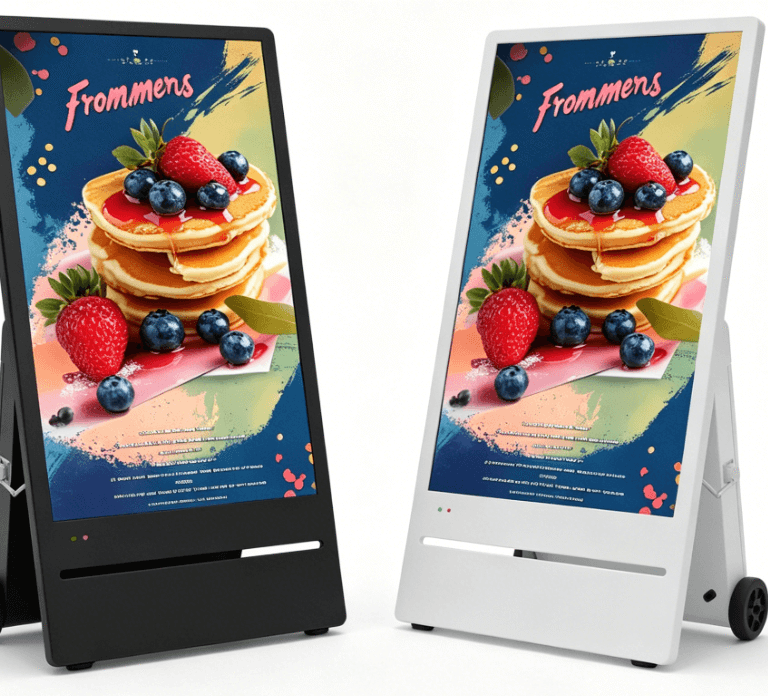
Technical Superiority in High-Ambient Light Environments
The primary challenge of outdoor advertising is solar interference. Standard indoor screens typically offer brightness levels between 250 and 500 nits, which appear washed out or completely black under direct sunlight.
Industrial-grade digital signage posters are engineered with high-brightness panels ranging from 2,000 to 3,500 nits. This ensures that the contrast ratio remains high enough for readability even in peak daylight. Furthermore, these displays often utilize specialized optical bonding and anti-reflective (AR) glass coatings. This reduces internal reflections and protects the panel from “blackening effects” caused by isotropic conversion when the liquid crystals reach high temperatures under solar load.
Environmental Resilience and Thermal Management
Outdoor deployment subjects electronics to moisture, dust, and temperature fluctuations. A critical advantage of professional digital signage posters is their Ingress Protection (IP) rating, typically IP65 or higher. This rating signifies that the internal components are completely protected against dust ingress and low-pressure water jets from any direction.
Thermal management is equally vital. High-brightness backlights generate significant internal heat, which is compounded by external solar radiation. Advanced outdoor posters incorporate:
Active Cooling Systems: Intelligent fan-based ventilation that adjusts speed based on internal thermal sensors.
Heat Exchangers: Closed-loop systems that protect internal electronics from outside air pollutants while dissipating heat.
Industrial-Grade Components: Capacitors and power supplies rated for wide operating temperature ranges, often from -20°C to +50°C.
The Evolution of Mobility: Battery-Powered Portability
A significant advancement in this sector is the development of portable, battery-operated outdoor posters. Traditional outdoor signage requires fixed installation and proximity to a power grid, which limits placement flexibility.
Modern portable solutions, such as those featuring integrated lithium-ion or LiFePO4 battery packs, allow for rapid deployment in high-traffic areas like pop-up events, sidewalk promotions, or transport hubs. These units typically provide 8 to 14 hours of continuous operation on a single charge. This mobility eliminates the need for expensive trenching or electrical permits, allowing businesses to place their message exactly where the audience is moving at any given hour.
Operational Efficiency and Content Agility
From a logistical perspective, digital signage posters remove the recurring costs associated with printing, shipping, and manually installing vinyl or paper advertisements.
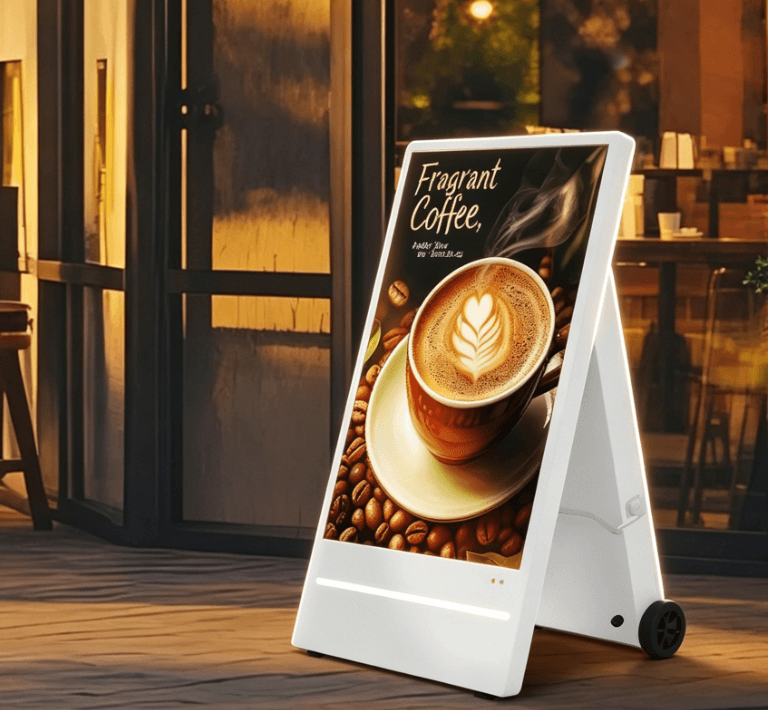
Through a Centralized Management System (CMS), operators can update content across an entire fleet of displays globally in seconds. This allows for:
Day-Parting: Showing breakfast advertisements in the morning and dinner specials in the evening.
Dynamic Triggers: Adjusting content based on local weather conditions or inventory levels.
Emergency Alerts: Utilizing the screens for public safety announcements when necessary.
Comparative Analysis: Digital vs. Static Outdoor Media
The following table outlines the fundamental differences between traditional static posters and modern digital signage posters.
| Feature | Static Print Posters | Digital Signage Posters |
| Visibility | Dependent on external lighting | Self-emissive, high-brightness (2500+ nits) |
| Update Speed | Days/Weeks (Printing & Logistics) | Real-time (Cloud-based CMS) |
| Durability | Vulnerable to fading and tearing | Ruggedized, IP65-rated enclosures |
| Initial Cost | Low | High (CapEx) |
| Long-term Cost | High (Recurring labor/materials) | Low (Software management) |
| Engagement | Static image only | Video, animation, and interactivity |
| Data Tracking | Estimated (Foot traffic counts) | Accurate (Log files, optional AI sensors) |
Material Specifications and Durability Standards
When evaluating a digital signage poster for outdoor use, engineers prioritize material integrity. Most high-end enclosures are constructed from galvanized steel or aluminum with a powder-coated finish to prevent corrosion in coastal or high-humidity environments.
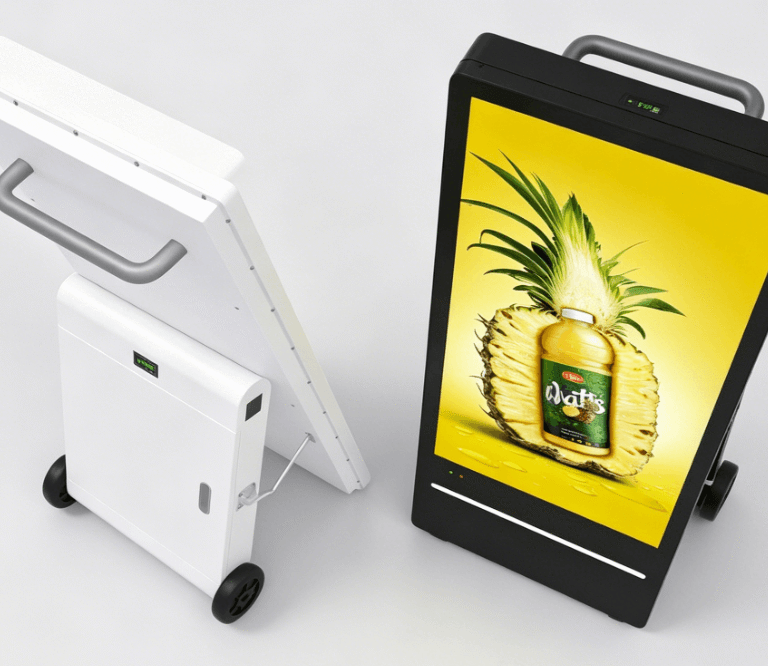
The front interface usually consists of tempered safety glass. This glass is not only designed to be vandal-resistant (often meeting IK10 impact ratings) but also acts as a UV filter. UV radiation can degrade the color filters within an LCD panel over time; therefore, a high-quality outdoor display will include UV-resistant films to extend the lifespan of the hardware.
Strategic Implementation and Placement
For maximum effectiveness, the deployment of outdoor digital posters should consider the “dwell time” of the target audience. In areas where people are moving quickly (e.g., alongside highways), high-impact, short-duration visuals are required. In pedestrian zones or bus stops, the digital poster can serve more detailed informational content.
The integration of battery-powered portable units has changed the “suitability matching” for many businesses. For instance, a luxury retail brand might deploy a sleek, portable digital poster at the entrance of a shopping plaza during peak hours and move it inside for security at night. This level of flexibility ensures that the advertisement is always positioned in the optimal viewing “sweet spot.”
FAQ
1. What is the ideal brightness for an outdoor digital signage poster?
For most outdoor environments, a minimum of 2,000 nits is required to overcome indirect sunlight. If the screen will face direct southern sunlight, 2,500 to 3,500 nits is recommended to maintain a high contrast ratio and prevent the screen from looking dim.
2. How does a digital signage poster handle extreme rain or snow?
Professional outdoor posters are built with IP65 or IP66 enclosures. These are sealed against moisture and use waterproof gaskets. Furthermore, many units include internal heating elements to prevent components from freezing and to eliminate condensation on the glass during rapid temperature shifts.
3. Can battery-powered outdoor posters run 24/7?
A: Most battery-powered units are designed for “shift-based” use, lasting 8-14 hours. For 24/7 operation, they are typically plugged into a standard power outlet. The battery feature is intended for maximum flexibility during business hours or events where cord safety and placement are priorities.
4. What is the average lifespan of an outdoor digital signage panel?
Most industrial-grade panels are rated for 50,000 to 70,000 hours of continuous use. With proper thermal management and by utilizing “auto-dimming” sensors that lower brightness at night, the operational life can extend beyond 7 years of daily use.
5.Are these screens vandal-proof?
While no screen is indestructible, outdoor digital signage posters usually feature 5mm to 8mm tempered glass with an IK10 rating. This means they can withstand significant impacts without the glass shattering or the panel being damaged.
Reference Sources
International Electrotechnical Commission (IEC)
Society for Information Display (SID)